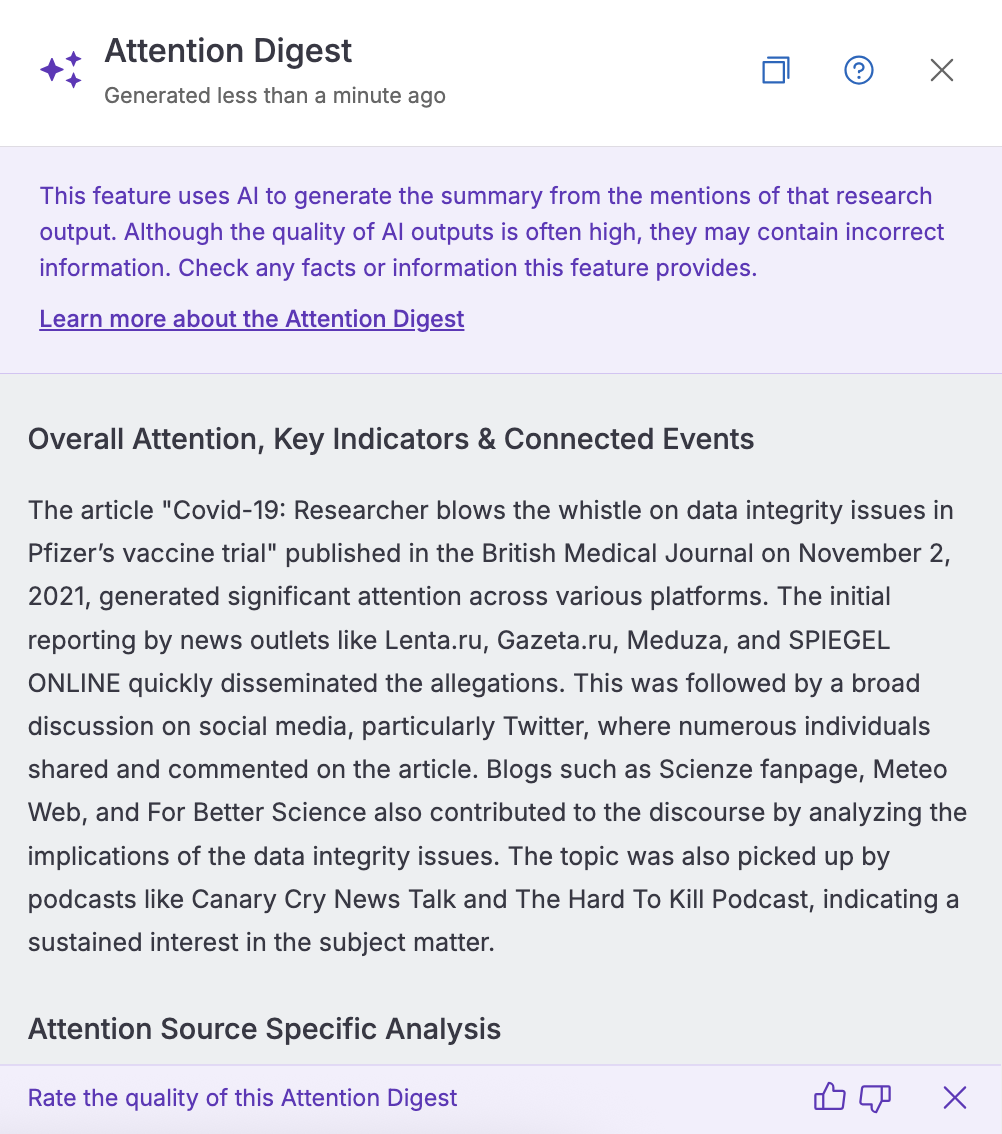
Altmetric Attention Digest
What is the Altmetric Attention Digest?
The Altmetric Attention Digest is an AI-powered feature designed to move beyond simple attention metrics and provide users with a clear, concise, and narrative summary of a research output's attention data.
It uses a powerful Large Language Model (Gemini 2.5 Flash) to synthesize information from various attention sources—including news, policy documents, social media, and citations—to create an on-demand, high-quality and easily interpretable report on the research's influence, while also enabling more advanced prompt refinement and deeper analytical outputs.
Attention Digests will be available for research outputs with a minimum of 5 mentions (excluding mentions from discontinued sources).
Why is the Altmetric Attention Digest Useful?
The Digest addresses the challenge of making sense of complex attention data, enabling users to:
Quickly Grasp Impact: Instantly understand the significance of a research output's attention, saving time on manual analysis.
Identify Key Events: Highlight specific connected events or trigger points that led to notable surges in attention (e.g., a policy change or a press release).
Focus on Authority: Prioritize and synthesize information from key indicators of impact, such as policy documents, clinical guidelines, and prominent news media.
Facilitate Communication: Generate ready-to-share narratives for stakeholders, making it easy to convey the reach and influence of research for grant reports, tenure reviews, or internal strategy briefings.
Streamline Reporting: Provide a comprehensive, high-level summary that connects the quantitative metrics with the qualitative context.
Incorporate Sentiment Context: Integrate insights from Altmetric’s Sentiment Analysis to provide additional context on how research is being discussed, complementing the narrative with signals about tone and perception.
Improve Consistency Over Time: Highlight both peak activity periods and notable mentions from quieter periods, including viral or high-impact posts, to ensure a more balanced and representative view of how attention evolves over time.
The Digest is distinct from Sentiment Analysis. While Sentiment Analysis categorizes the tone (positive/negative), the Digest provides a narrative overview of what is being said, where, and when, focusing on building a coherent story of impact.
Altmetric Attention Digest in Details Pages
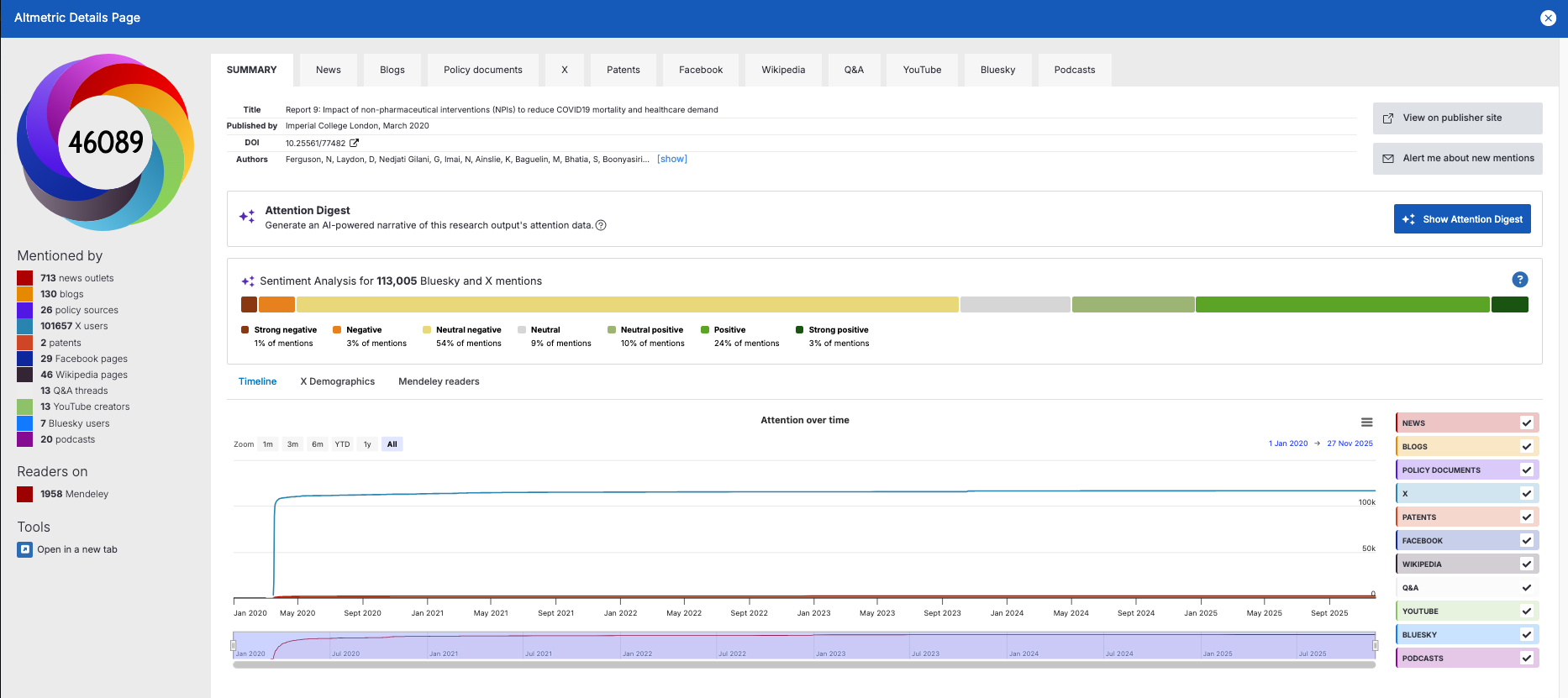
The Digest is an on-demand feature accessible from the Details Page of any research output.
Digest Generation and Display
Trigger: On the Details Page, Altmetric Explorer users will see a clear "Show Attention Digest" Call-to-Action (CTA) button, typically located near the main attention score breakdown.
On-Demand Process: When the CTA is clicked, the system initiates the process to generate the Digest. This process is resource-intensive and is limited to once per 24 hours per research output. If a Digest was generated within the last 24 hours by any user, subsequent users will be shown the cached version.
The system will only create a brand new Digest if the underlying attention data (eligible mentions) for the research output has changed since the last Digest was generated. This means you may see a Digest with a timestamp older than 24 hours if no new attention data has been recorded, and this Digest will be the most up-to-date summary of the existing data.
Display: The generated Digest appears in a pop-out drawer overlay on the Details Page.
Content Structure
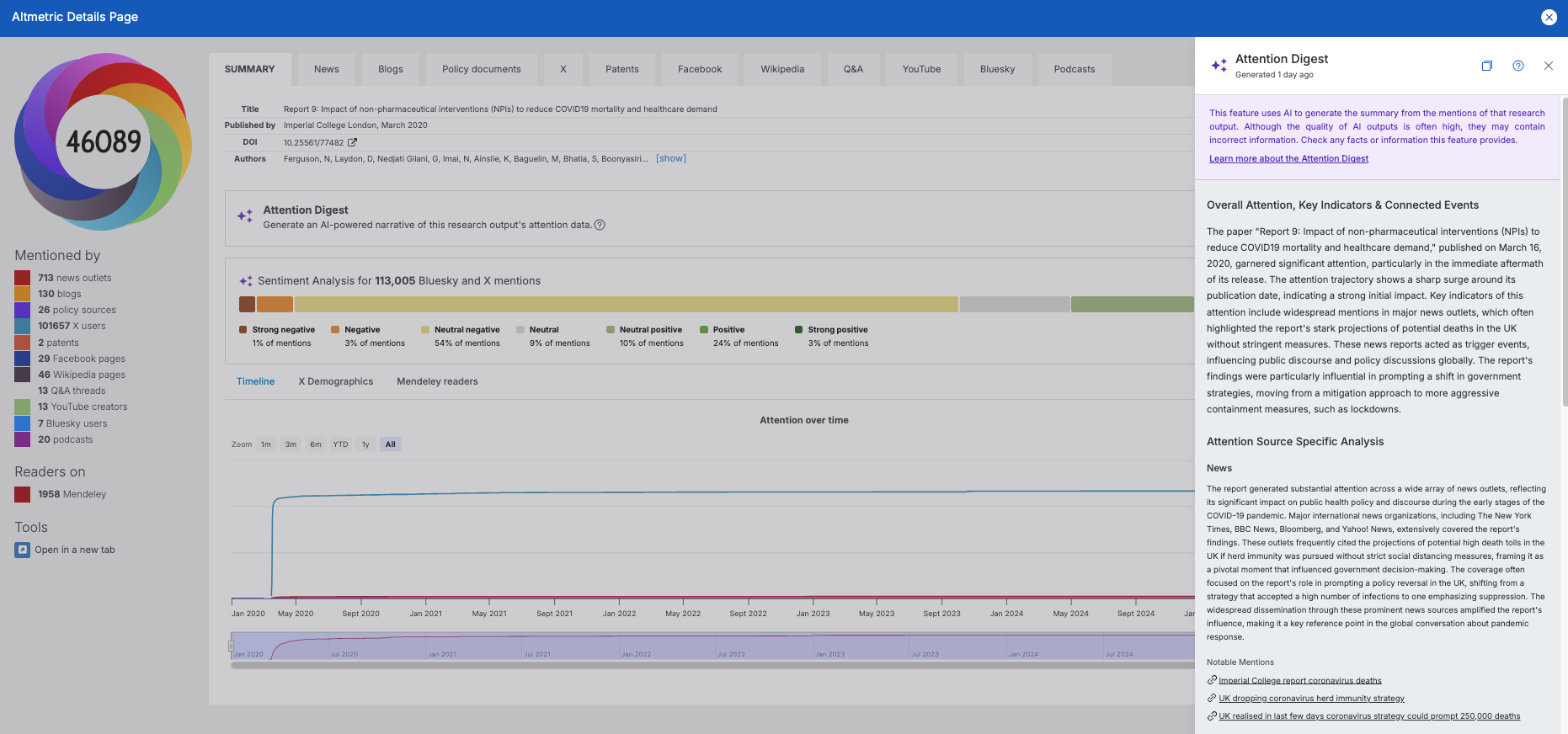
The generated Digest follows a clear, hierarchical structure:
High-Level Narrative Summary: This initial paragraph provides a concise, overall summary of the research's impact, synthesizing the most notable events and attention highlights.
Source-Specific Insights: This section provides more detailed information, breaking down the impact by source type (e.g., News outlets, Policy documents). It includes:
Synthesized findings regarding attention from that source.
Specific examples or links back to notable mentions to enable verification.
A structured approach to identifying and prioritising “notable mentions”, based on factors such as reach, engagement, source authority, and contextual relevance, ensuring the most impactful examples are surfaced.
Visibility of mentions across different time periods, including both spikes in attention and significant activity during quieter periods, to provide a more comprehensive and temporally balanced analysis.
Transparency and Footprint: The Digest is designed to incorporate a robust footprint where notable mentions have clear, accessible links back to their original sources. This enables users to verify the AI-generated information independently.
User feedback
When generating a Digest, you may see an option to provide feedback. This feedback helps us refine the AI model for more accurate content.