
Explorer filters: Search by Subject Area (FoR)
Within the Altmetric Explorers Advanced Search you can query the database by a Fields of Research (FoR) code to see relevant data.
Altmetric’s subject area data is provided by Dimensions. Subject areas are assigned at the article-level instead of a journal level, which allows for richer data searches as journals can cover a wide variety of topics. Articles published in journals that are classified as “multi-disciplinary” can now benefit from this more detailed analysis of their articles.
Is subject area information available for other output types, such as datasets?
At this time, our subject area information is available only for journal articles.
Quick search
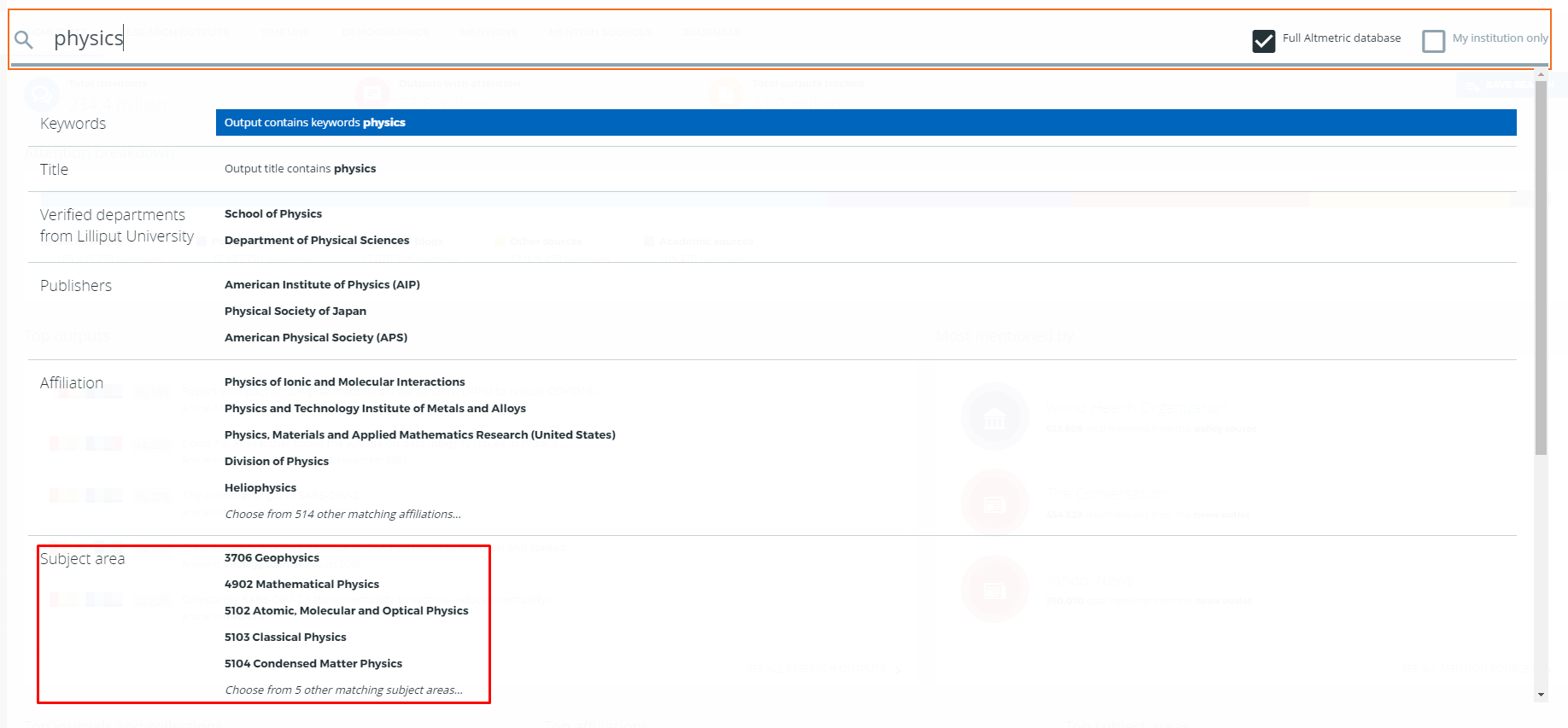
In the Quick Search, you can type in the name of subject area or an FoR code, and see a list of suggestions of matching subjects, as shown in the example below:
Advanced search
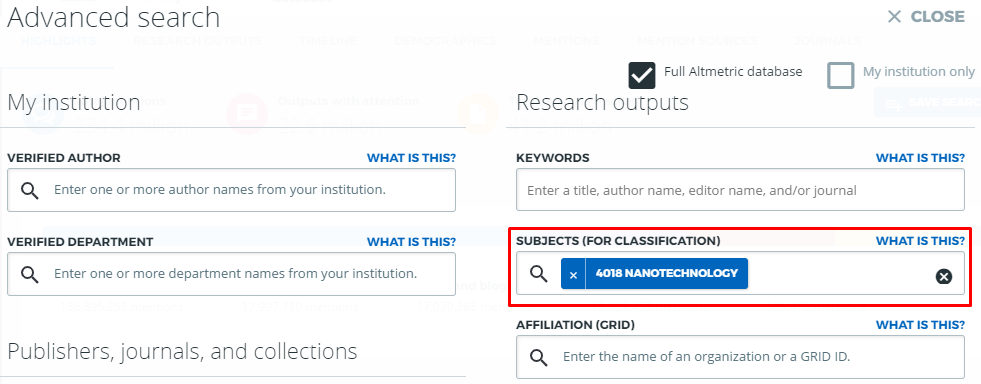
In the Advanced Search, you can select one or more subjects to create a more detailed search query.
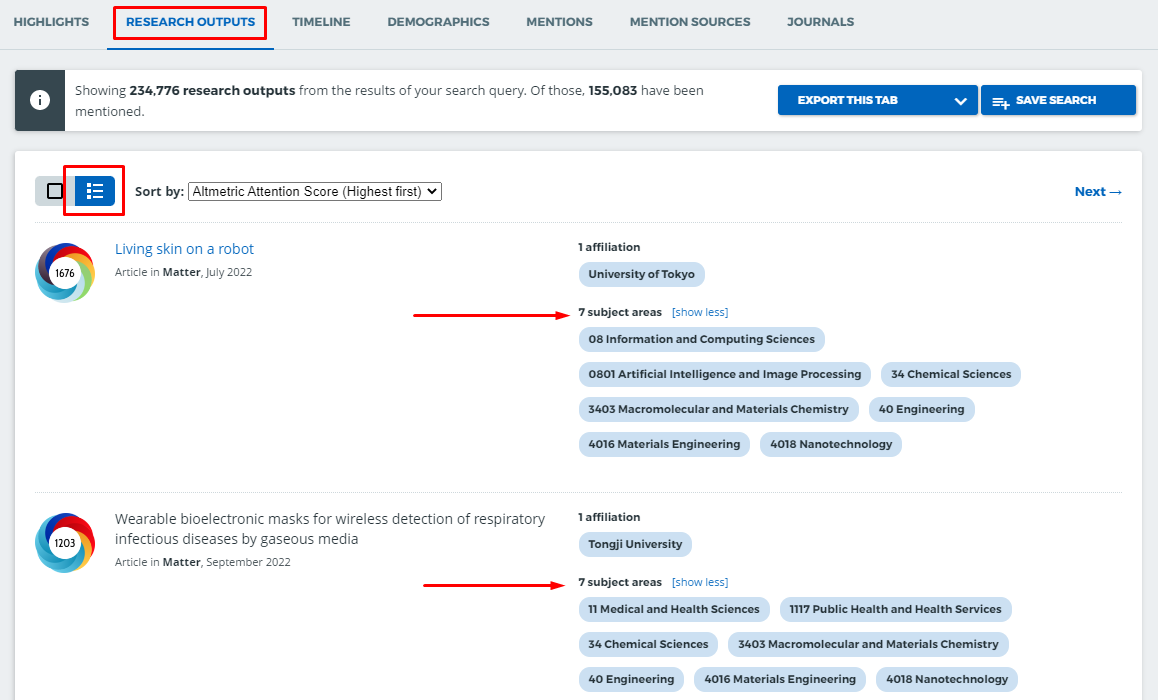
In the Research Outputs tab, you can also view the subject areas for individual research outputs in your search results - simply switch to the ‘List view’ of the Research Outputs tab to view these subject labels.
How do I see the top subject areas for my search?
The Highlights tab in the Altmetric Explorer now contains information about the top subject areas within your search query.
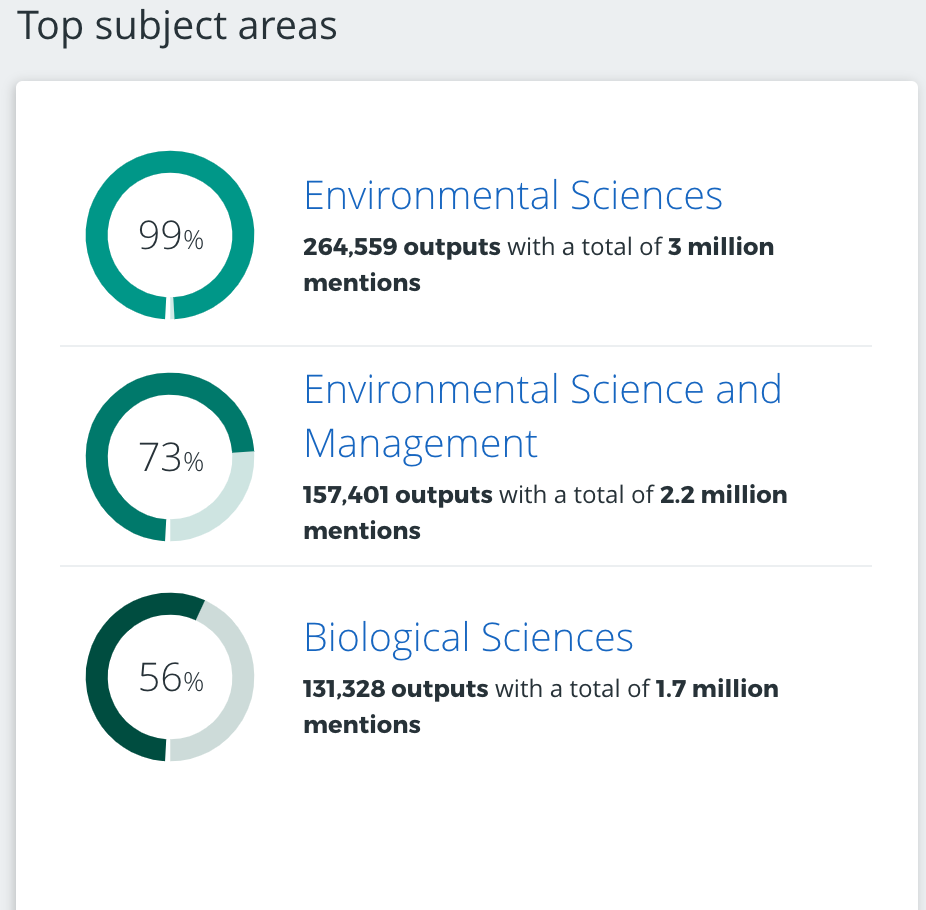
Top subjects are determined by identifying the FoR codes whose outputs hold the greatest share of attention within the given search query.
The percentages are calculated by taking the total number of mentions associated with outputs with those FoR codes, and dividing by the total number of mentions in the search query.
How do I export affiliations data from the Explorer?
From the Research Outputs and Mentions tabs, you can also export the affiliations data using the CSV exports and the Explorer API.
Update to the Fields of Research (FoR) classification
The Fields of Research (FoR) classification is a component of the 2020 Australian and New Zealand Standard Research Classification (ANZSRC) system. The ANZSRC was initially developed in 2008 with a revised version being released in 2020. The new classifications better reflect current research while also improving coverage, coherence, and consistency across subject areas. The new FoR version is based on the revised ANZSRC 2020 system and includes several new categories as well as category splits and merges.
There are three related ANZSRC classifications: Fields of Research (FoR), Type of Activity (ToA), and Socio-economic Objective (SEO). Only FoR is present in Altmetric.
The FoR has three hierarchical levels: Divisions, groups and fields. Division represents a broad subject area or research discipline, while groups and fields represent increasingly detailed subsets of these categories. The FoR codes cover all areas of academic research at a high level, so it works well for non-granular investigations by broad subject areas. Therefore, FoR is good for comparative analyses across all academia at a fairly high level.
The FoR Classifications are supplied by Dimensions and give us the ability to search the Altmetric database by defined subject areas. They have applied the classifications to research by emulating the divisions and group-levels of the FoR system using machine learning. In the current version we dropped the ‘Indigenous Studies’ division as well as the ‘other’ field from the group level. This reduced the division level categories from 23 to 22 and the group level categories from 213 to 171.
Altmetric Explorer has already been updated to utilize the news codes for any new searches.
We strongly advise updating and reviewing the areas below to the new codes by 30/01/2023 to continue getting relevant results.
Re run any existing flagged saved searches, update the FOR code and resave (don't forget to remove the old one)
Update links to any sharable saved searches that are being embedded in your site with links to your newly saved searches with 2020 codes
Update any saved Explorer API queries that use FOR codes
Following this update we will also be updating the following fields in the Altmetric API:
category_for_2008 - representing the old FoR classification version
category_for_2020 - representing the new FoR classification version
Please refer to our documentation for an overview of the updated API data schema. For details about the methods used to create the FoR ANZSRC 2020 machine learning training set and model, please read: Recategorizing research: Mapping from FoR 2008 to FoR 2020 in Dimensions